So, who's surprised that citizens, wherever in the world that they happen to reside, are to serve the interests of capital? Not me. Not George Bush. Not Thomas Friedman. Not Paul Krugman. Who's surprised that the citizens didn't realize that? George Bush, but not me. From their opposite sides of the globalization aisle, Krugman and Friedman aren't so surprised, either, but they're sorry about it.
All three are promoters and apologists for globalization, and so they support the Dubai Ports deal. The first premise of globalization is that capital can, will, and must move freely around the world. Nothing should stop a sale or get in the way of market efficiency. George Bush has shown over and over in the last five years what he is willing to fight for, and it is capitalism. Sometimes, no doubt in his own mind most of the time, he identifies capitalism with the US, the company of which he is president. But other times, the US seems to defy him, and to disagree with him about the right thing to do, and then he reveals that he doesn't understand a thing about the citizenry, or about the differences between living and shopping, or governing and deal-making, and, further, that he doesn't care one iota about the US when it is in disagreement with pure capitalism.
It seems to come as a surprise to all three of these globalizers that human society is not and does not seem to most people to be simply an outgrowth of a particular economic idea, capitalism, so they should pay attention to the symbolic power of turning our ports over to Dubai. Most people do not mind shopping at Walmart but that doesn't mean that they think of themselves simply as Walmart shoppers, or that they feel that their interests and Walmart's interests must necessarily be the same. At the end of the Cold War, capitalists declared, with much chest-pounding, that they had won. But, in fact, they did not give up a Marxist analysis of what makes us human. They continued to believe that people are essentially economic agents, they just thought that the value of capital had beat out the value of labor. According to Francis Fukuyama, lots of the neo-con theorists started out as Marxists. In fact, these guys didn't change their spots at all-they just changed their allegiance to the winning side.
What, therefore, should not come as a surprise to the citizens, and this includes our soldiers in Iraq, is the fact that they have value only insofar as they are useful to Bush and his capitalist "base". From
Bush's point of view, every citizen is a worker who should work for as little as possible. It doesn't matter, as far as he is concerned, whether the worker's employer is Dubai or the US or whether the worker himself is American or Chinese or Indian. Capital has its requirements and those come first-before making a decent society in the US (of course), and before national security, and before patriotism. The capitalists are perfectly willing to use patriotism (and religion) for their own ends (say, to gain control of Iraqi oil by going to war on other pretexts), but that doesn't mean that when the time comes to give up maximum profit, patriotic or religious concerns hold any weight in their deal-making.
These days, the news is full of conservative recanters-William Buckley, Fukuyama, Bruce Bartlett. They are alleging feelings of surprise and disquiet at the failure of the war machine to subdue Iraq. But in fact, of course, as progressives have known all along, the debacle of the Bush administration, from beginning (stealing the 2000 election) to end (importing a company from Dubai to run the ports),
with all the stations along the way (tax breaks for the rich, crony corruption, stupid and criminal war in Iraq, badly conceived education policies, bungled medicare drug bill, deaf, dumb, and blind policies on
global warming and other environmental issues, voting machine fraud, media payola, gutting of the federal agencies) is the natural outcome of corporate conservative capitalism, and especially the ideas of Ronald Reagan and his own cronies. What we have now is what you get when businessmen run the government like a corporation-short term thinking, public relations as policy, repeated attempts to do things on the cheap, careless attitudes toward things like torture and spying, contempt for everyone outside the inner circle, aggressiveness and secretiveness, lack of accountability, and just plain selfish arrogant ignorance. Who knows whether their intentions are good or not? It could
be that, after a generation of free-market orthodoxy, they just don't know any better.
Monday, February 27, 2006
And another commentator who gets things
Marxism Through the Looking Glass by Jane Smiley


Sunday, February 26, 2006
Capitalism is a sickness
Why did Ayn Rand hate folk music?
Why does Bill O'Reilly rant about the ACLU in nearly the exact same sentences Hitler used to describe communists, labor organizers, Russians, and Jews?
In neither case are the alleged explanations the honest truth. Ayn Rand hated folk music because it was inherently harder to privatize. She talked about it's naiivete, religiousity, endorsement of rural communalism and pastoralism, etc. etc., none of which are traits of all folk music. What makes folk music folk music is the fact that it's built out of other folk music. And economic royalism has decreed that music needs to be commoditized, privatized, and locked up. In other words, sheer economic determinism made Ayn Rand speak for or against anything.
Why Bill O'Reilly attacks the ACLU more than any other group is made immediately clear looking at Fox News' history of attempting censorship by lawsuit. They sued T-shirt makers who made fun of them. O'Reilly and Fox News sued Al Franken for mocking their fair-and-balanced slogan. They even started to sue Fox itself because the "news crawl" on cartoon TV sets in The Simpsons mocked the Fox News chiron. In all but the last case, whenever Fox has tried to harrass critics into silence the ACLU has stepped in on behalf of the victims and shut Fox down. Therefore, O'Reilly's money source and his book sales determine what he hates.
Capitalism has not been with us that long. Only since the post-war era, in fact. Before that you had some of the components, but they weren't welded into an ideology. Slavery existed all over the world for a long time as a necessary evil, but no one turned it into a virtue until it became bound into the nationalism of the American South before and during the Civil War. That slavery-as-ideology is similar to what capitalism really is.
In the 1940s the US noticed that command economies - essentially still on a wartime footing - were rapidly reindustrializing in the Soviet Union and most of eastern Europe. It was clear that both the communists and the Kuomintang in China were also going to follow a command economy of some sort, with Chiang Kai-Shiek leaning towards Mussolini's corporatism and Mao imitating Lenin and Stalin. US The State Department has documents showing that Marxism was seen as a real ideological threat already as the war ended. It provided a simple analysis of politics, war, economics and government. Economic conditions trumped everything else, and commerce had to be subdued by government in every sphere of activity. The United States government consciously decided to support a counter-ideology, which we now know as capitalism. As a mirror-image of Marxism-Leninism, it would agree that economics was the only "real" dimension of human activity, the one that controlled and created all the others. But it would fanatically invert the central Marxist doctrine that commerce was always subordinate to government. Government must always be subordinate to commerce, and everything else would fall into place magically. Of course, most places in the world found Marxism more inherently acceptable, so the ideology was modified to say that, just as communism was something that would be arrived at for real only after generations of building socialism in the Marxist ideology, real capitalism would only be arrived at after first establishing increasing economic freedom, quite often through mercantilism, foreign aid and command economies.
This simple inversion of Marxism-Leninism had a parallel in the domestic US political culture. The "neoconservatives," among other features, were people who had believed, crudely, that Marxism had all the answers and Russia was always right - either Russia as it was (Stalin) or Russia as it ought to have been (Trotsky). Disillusioned - or just feeling disenfranchised - they hadimmediately flipped to a posture of "capitalism has all the answers and America is always right" (later changing to "Israel is always right" after the 1960s started).
The earlier "anti-Bolshevism" of the US government had been in the form of Red Scares, with Bolshevism seen as anarchy and mass murder of the deserving elites by a Jacobin mob. That had blended, in the 1930s, with a strong attraction of fascism for the rich and powerful of America. That culminated in an attempted coup against Roosevelt in the mid-30s, as Smedley Butler reported. What I believe the business elites were most impressed with was that Mussolini and Hitler were able to lead the masses to act against their interests and in the interests of rich elites without and overdependence on religion. Clearly, Hitler and Mussolini cited the Church and the Nation nonstop, but they also adapted the language of the left dissidents and modified it to twist their masses into ideological knots. One of the most important things they accomplished was creating enough confusion that people couldn't tell the ideologues paid to do the rich man's bidding from the spontaneous ones. Astroturf, as we call it now, was what brought fascism to power.
Thus, by the 1940s and 50s there was US government support for a "capitalist" and specifically "anti-Marxist" ideology. There was tremendous elite support for it - Herbert Hoover repurposed his Stanford Institute on War, Peace and Revolution as an explicit source of "capitalist" propaganda, making it the very first "think tank" that was only for propaganda purposes (FDR's were for problem-solving).
It was against that background that the coming to prominence of the Young Americans for Freedom, Barry Goldwater, Ayn Rand and her Objectivism, and what became the Libertarian Party is easy to understand. In essence, they were all beneficiaries of astroturf. While they pretended to attack the State Department, out of sheer demagoguery, in fact they were in a tight alliance of the State Department, the Defense Department, the OSS/CIA/NSA, and so on, all shoulder to shoulder in complete agreement on goals but only quibbling over tactics (with the astroturf rabble rousers deliberately always advocating impossible and insane tactics to look like true rebels).
By the 1970s, elites and government agents were so successful at fooling the American people and the masses of much of the world that they had become complacent. That's the true meaning behind the (Lewis) Powell memo. Justice Powell claimed capitalism had no ideological defenders, unlike Marxism, and that it needed such a defender, since Marxism was being advocated all over society and government. Of course, that was completely false. In H.L. Mencken's time, as he noted, anything outside of the most pro-business, pro-rich, pro-corporate economic teaching was completely banned from American universities, and only against that background did the presence of some left, liberal, and even Marxist professors (and only a few, most not connected with economics courses) on American campuses later on become a profusion. More importantaly, as I have indicated, Marxism had a few paltry impoverished defenders here and there, and capitalism had a huge machine built in behind it.
So Powell, not an idiot, could not have meant what he wrote. What he was saying was that he felt the capitalism machine was getting slack and complacent and that its propaganda would suffer, and people would start turning against the super-rich and the multinational corporations and the large financial institutions, and start clamoring for relief. Therefore, to head that off, the Cold War would have to be revamped, more money poured directly not just into capitalist propaganda, but into a group of parasites whose only career would be propagandizing the masses on behalf of capitalism, and luring working class people into supporting pro-capitalist policies through cultural conflict. One of the totally intentional ironies of complete business control of America's media, educational system and historical training is that no average Americans were ever exposed to Antonio Gramsci (who far predates people like Guy DeBord or Marshall McCluhan), but clearly the elites and their defenders were close students of his theories.
We all know the fallout from that - Thomas Frank's What's the Matter with Kansas? deals with how well the culture wars played out. The Cold War was indeed ramped up for no reason other than elite interests. Then, just before Reagan and Bush yanked that out from under the masses, a false existential threat from terrorism* was created in the 1980s. The elites and their representatives embraced deficit spending on the military-industrial complex not just for its own sake, but as a strategy to privatize the social network, reduce the educational level of the masses to nonthreatening levels, and create enough unemployment and underemployment to assure the death of unions and the supremacy of the elites, as well as slowly dissolving the middle class.
When I say that capitalism is a sickness, I don't mean business, commerce or profits are a sickness. But privatization of everything human beings do is a sickness. It's the mental illness fallout from trying to shoehorn all human activity into a tight-fitting capitalist mold. The tendency to capitalize everything is perhaps a necessary evil, something we have to allow around because eliminating it would be even worse. But making it not only a virtue, but the only virtue, is a recipe for a sick society. Given where the worst communist societies started from, in fact, I think it's a recipe for a sicker society even than theirs were.
*When I say the existential threat of terrorism was false, I mean it. Had the elites and their surrogates truly regarded international terrorism as a threat they would not have done the following:
1. Ignored all right wing terrorism, from the most lethal terrorist bombing in decades - a fascist bomb in Bologna Italy - to the right-wing terrorists who actually shot the Pope. The Reaganites played politics with that by pretending the KGB and Russia and Bulgaria were behind it, but they knew, we can now show, all along that that was a lie.
2. Played politics with other terrorist incidents. For instance, they milked a discotheque bomging in Berlin to justify a Mussolini-like attack on Libya, then turned around and, within weeks, declared that it was an Iranian sponsored bombing.
3. Most importantly, funded Islamists all over the world, including Al Qaeda, the mujaheddin in general, and the Taliban. Similarly, if Israel really regarded "Islamic terrorism" as a true existential threat, then their government would never have funded Hamas, a splinter of the Moslem Brotherhood, nor given it status as a recognized charity. They would have struck back at terrorist groups, as they did, but not played politics by pretending the largely military group the PLO was a terrorist organization, nor by lying and saying groups who targetted both the PLO and Israel were in fact PLO-controlled. This is leaving alone the American funding and training and harboring and general sponsorship of international terrorism in Cuba, Nicaragua, El Salvador, Guatemala, Namibia, Angola, and so on. Or direct US terrorism in Southeast Asia from the 1950s through the late 1980s.
The truth is, terrorism in the 1980s was a useful tool for the elites, and nothing more.
Why does Bill O'Reilly rant about the ACLU in nearly the exact same sentences Hitler used to describe communists, labor organizers, Russians, and Jews?
In neither case are the alleged explanations the honest truth. Ayn Rand hated folk music because it was inherently harder to privatize. She talked about it's naiivete, religiousity, endorsement of rural communalism and pastoralism, etc. etc., none of which are traits of all folk music. What makes folk music folk music is the fact that it's built out of other folk music. And economic royalism has decreed that music needs to be commoditized, privatized, and locked up. In other words, sheer economic determinism made Ayn Rand speak for or against anything.
Capitalism has not been with us that long. Only since the post-war era, in fact. Before that you had some of the components, but they weren't welded into an ideology. Slavery existed all over the world for a long time as a necessary evil, but no one turned it into a virtue until it became bound into the nationalism of the American South before and during the Civil War. That slavery-as-ideology is similar to what capitalism really is.
In the 1940s the US noticed that command economies - essentially still on a wartime footing - were rapidly reindustrializing in the Soviet Union and most of eastern Europe. It was clear that both the communists and the Kuomintang in China were also going to follow a command economy of some sort, with Chiang Kai-Shiek leaning towards Mussolini's corporatism and Mao imitating Lenin and Stalin. US The State Department has documents showing that Marxism was seen as a real ideological threat already as the war ended. It provided a simple analysis of politics, war, economics and government. Economic conditions trumped everything else, and commerce had to be subdued by government in every sphere of activity. The United States government consciously decided to support a counter-ideology, which we now know as capitalism. As a mirror-image of Marxism-Leninism, it would agree that economics was the only "real" dimension of human activity, the one that controlled and created all the others. But it would fanatically invert the central Marxist doctrine that commerce was always subordinate to government. Government must always be subordinate to commerce, and everything else would fall into place magically. Of course, most places in the world found Marxism more inherently acceptable, so the ideology was modified to say that, just as communism was something that would be arrived at for real only after generations of building socialism in the Marxist ideology, real capitalism would only be arrived at after first establishing increasing economic freedom, quite often through mercantilism, foreign aid and command economies.
This simple inversion of Marxism-Leninism had a parallel in the domestic US political culture. The "neoconservatives," among other features, were people who had believed, crudely, that Marxism had all the answers and Russia was always right - either Russia as it was (Stalin) or Russia as it ought to have been (Trotsky). Disillusioned - or just feeling disenfranchised - they hadimmediately flipped to a posture of "capitalism has all the answers and America is always right" (later changing to "Israel is always right" after the 1960s started).
The earlier "anti-Bolshevism" of the US government had been in the form of Red Scares, with Bolshevism seen as anarchy and mass murder of the deserving elites by a Jacobin mob. That had blended, in the 1930s, with a strong attraction of fascism for the rich and powerful of America. That culminated in an attempted coup against Roosevelt in the mid-30s, as Smedley Butler reported. What I believe the business elites were most impressed with was that Mussolini and Hitler were able to lead the masses to act against their interests and in the interests of rich elites without and overdependence on religion. Clearly, Hitler and Mussolini cited the Church and the Nation nonstop, but they also adapted the language of the left dissidents and modified it to twist their masses into ideological knots. One of the most important things they accomplished was creating enough confusion that people couldn't tell the ideologues paid to do the rich man's bidding from the spontaneous ones. Astroturf, as we call it now, was what brought fascism to power.
Thus, by the 1940s and 50s there was US government support for a "capitalist" and specifically "anti-Marxist" ideology. There was tremendous elite support for it - Herbert Hoover repurposed his Stanford Institute on War, Peace and Revolution as an explicit source of "capitalist" propaganda, making it the very first "think tank" that was only for propaganda purposes (FDR's were for problem-solving).
It was against that background that the coming to prominence of the Young Americans for Freedom, Barry Goldwater, Ayn Rand and her Objectivism, and what became the Libertarian Party is easy to understand. In essence, they were all beneficiaries of astroturf. While they pretended to attack the State Department, out of sheer demagoguery, in fact they were in a tight alliance of the State Department, the Defense Department, the OSS/CIA/NSA, and so on, all shoulder to shoulder in complete agreement on goals but only quibbling over tactics (with the astroturf rabble rousers deliberately always advocating impossible and insane tactics to look like true rebels).
By the 1970s, elites and government agents were so successful at fooling the American people and the masses of much of the world that they had become complacent. That's the true meaning behind the (Lewis) Powell memo. Justice Powell claimed capitalism had no ideological defenders, unlike Marxism, and that it needed such a defender, since Marxism was being advocated all over society and government. Of course, that was completely false. In H.L. Mencken's time, as he noted, anything outside of the most pro-business, pro-rich, pro-corporate economic teaching was completely banned from American universities, and only against that background did the presence of some left, liberal, and even Marxist professors (and only a few, most not connected with economics courses) on American campuses later on become a profusion. More importantaly, as I have indicated, Marxism had a few paltry impoverished defenders here and there, and capitalism had a huge machine built in behind it.
So Powell, not an idiot, could not have meant what he wrote. What he was saying was that he felt the capitalism machine was getting slack and complacent and that its propaganda would suffer, and people would start turning against the super-rich and the multinational corporations and the large financial institutions, and start clamoring for relief. Therefore, to head that off, the Cold War would have to be revamped, more money poured directly not just into capitalist propaganda, but into a group of parasites whose only career would be propagandizing the masses on behalf of capitalism, and luring working class people into supporting pro-capitalist policies through cultural conflict. One of the totally intentional ironies of complete business control of America's media, educational system and historical training is that no average Americans were ever exposed to Antonio Gramsci (who far predates people like Guy DeBord or Marshall McCluhan), but clearly the elites and their defenders were close students of his theories.
We all know the fallout from that - Thomas Frank's What's the Matter with Kansas? deals with how well the culture wars played out. The Cold War was indeed ramped up for no reason other than elite interests. Then, just before Reagan and Bush yanked that out from under the masses, a false existential threat from terrorism* was created in the 1980s. The elites and their representatives embraced deficit spending on the military-industrial complex not just for its own sake, but as a strategy to privatize the social network, reduce the educational level of the masses to nonthreatening levels, and create enough unemployment and underemployment to assure the death of unions and the supremacy of the elites, as well as slowly dissolving the middle class.
When I say that capitalism is a sickness, I don't mean business, commerce or profits are a sickness. But privatization of everything human beings do is a sickness. It's the mental illness fallout from trying to shoehorn all human activity into a tight-fitting capitalist mold. The tendency to capitalize everything is perhaps a necessary evil, something we have to allow around because eliminating it would be even worse. But making it not only a virtue, but the only virtue, is a recipe for a sick society. Given where the worst communist societies started from, in fact, I think it's a recipe for a sicker society even than theirs were.
*When I say the existential threat of terrorism was false, I mean it. Had the elites and their surrogates truly regarded international terrorism as a threat they would not have done the following:
1. Ignored all right wing terrorism, from the most lethal terrorist bombing in decades - a fascist bomb in Bologna Italy - to the right-wing terrorists who actually shot the Pope. The Reaganites played politics with that by pretending the KGB and Russia and Bulgaria were behind it, but they knew, we can now show, all along that that was a lie.
2. Played politics with other terrorist incidents. For instance, they milked a discotheque bomging in Berlin to justify a Mussolini-like attack on Libya, then turned around and, within weeks, declared that it was an Iranian sponsored bombing.
3. Most importantly, funded Islamists all over the world, including Al Qaeda, the mujaheddin in general, and the Taliban. Similarly, if Israel really regarded "Islamic terrorism" as a true existential threat, then their government would never have funded Hamas, a splinter of the Moslem Brotherhood, nor given it status as a recognized charity. They would have struck back at terrorist groups, as they did, but not played politics by pretending the largely military group the PLO was a terrorist organization, nor by lying and saying groups who targetted both the PLO and Israel were in fact PLO-controlled. This is leaving alone the American funding and training and harboring and general sponsorship of international terrorism in Cuba, Nicaragua, El Salvador, Guatemala, Namibia, Angola, and so on. Or direct US terrorism in Southeast Asia from the 1950s through the late 1980s.
The truth is, terrorism in the 1980s was a useful tool for the elites, and nothing more.
Friday, February 24, 2006
Miscellany
The new link on the side to Comics Curmudgeon is interesting to me for several reasons. It's a good, funny weblog. Had Josh's site not existed, I would now be doing a comics blog (specializing, probably, in recent, alternative and also online comics, but including representative samples of the dying newspaper breed) instead of this "right-wing infection of science fiction" blog. One reason I would is because I miss The Funny Paper from the Baltimore City Paper by Scacca and MacLeod. Josh Fruhlinger is a worthy successor: he lives in Baltimore and reads the comics faithfully, and has a similarly snarky tone to Scacca and MacLeod, who've both moved on to bigger things. For my money, they were funnier than Josh, but given that there were two of them, being paid to do the column, not more than twice as funny. But that's not faint praise for Comics Curmudgeon. The Funny Paper was often my favorite column - I've gotten grown up enough that very little really makes me laugh and Scacca and Macleod usually delivered.
Very rarely do I completely disagree with "Ruben Bolling" of "Tom the Dancing Bug," but I did when he downplayed the importance of the Taliban bombing the millennia-old Buddhist mountain carvings in Afghanistan. Yes, the treatment of women under the Taliban was reprehensible, but that demolition was the destruction of symbols of tolerance and respect for a variety of traditions in Afghanistan, and a declaration of war on anything not conforming to the Talibs. Symbolic things like that, including flags and mosques/shrines, have importance beyond themselves as repositories for people's beliefs that they can act out of motives besides venality. In light of that, I think the unpresident almost got it right when he said destroying the shrine showed the bombers to be the enemies of everyone in Iraq. That's the kind of thing that builds for the future. 20 years from now we'll still be thanking the bombers for ethnic violence in and around Iraq, quite possibly.
Some people can only express their gratitude for the democracy and freedom of America by flag veneration, and that's why the rest of us have to at least show a modicum of respect for that fact. What the bombers did was like burning the original editions of the Declaration of Independence and the Constitution and melting the Liberty Bell (as well as, and I'm not forgetting it, killing several people that day). This is unlike assassinating government leaders or killing American GIs, both of which are legitimate military activities.
If I had had my way the American aggression in Iraq would have been a miserable failure, but without building for future, perhaps endless, ethnic/religious strife. I got the first part of my wish.
By the way, only a complete moral idiot would have wanted "America to win in Iraq." Even a child could tell you that would only lead to further fascist repression domestically as Wussolini beat his chest over his triumphs, then to aggression against Syria and Iran and probably a dozen other countries until ALL the troops were used up and the rest of the world was scrambling for ways to make the United States pay for its blindness, ways which it would locate fairly rapidly.
I haven't forgotten James Hogan's Kicking the Sacred Cow - i'll do a quick survey of why I think it's unfortunate and wrong. Then I can move to the economic stuff that's more central to my weblog. Then, finally, once I've established a few examples, principles, even utility posts, I can get back to what I normally do, which is introduce humor into these, so far, dark and fairly strident broadsides.
Very rarely do I completely disagree with "Ruben Bolling" of "Tom the Dancing Bug," but I did when he downplayed the importance of the Taliban bombing the millennia-old Buddhist mountain carvings in Afghanistan. Yes, the treatment of women under the Taliban was reprehensible, but that demolition was the destruction of symbols of tolerance and respect for a variety of traditions in Afghanistan, and a declaration of war on anything not conforming to the Talibs. Symbolic things like that, including flags and mosques/shrines, have importance beyond themselves as repositories for people's beliefs that they can act out of motives besides venality. In light of that, I think the unpresident almost got it right when he said destroying the shrine showed the bombers to be the enemies of everyone in Iraq. That's the kind of thing that builds for the future. 20 years from now we'll still be thanking the bombers for ethnic violence in and around Iraq, quite possibly.
Some people can only express their gratitude for the democracy and freedom of America by flag veneration, and that's why the rest of us have to at least show a modicum of respect for that fact. What the bombers did was like burning the original editions of the Declaration of Independence and the Constitution and melting the Liberty Bell (as well as, and I'm not forgetting it, killing several people that day). This is unlike assassinating government leaders or killing American GIs, both of which are legitimate military activities.
If I had had my way the American aggression in Iraq would have been a miserable failure, but without building for future, perhaps endless, ethnic/religious strife. I got the first part of my wish.
By the way, only a complete moral idiot would have wanted "America to win in Iraq." Even a child could tell you that would only lead to further fascist repression domestically as Wussolini beat his chest over his triumphs, then to aggression against Syria and Iran and probably a dozen other countries until ALL the troops were used up and the rest of the world was scrambling for ways to make the United States pay for its blindness, ways which it would locate fairly rapidly.
I haven't forgotten James Hogan's Kicking the Sacred Cow - i'll do a quick survey of why I think it's unfortunate and wrong. Then I can move to the economic stuff that's more central to my weblog. Then, finally, once I've established a few examples, principles, even utility posts, I can get back to what I normally do, which is introduce humor into these, so far, dark and fairly strident broadsides.
Tuesday, February 21, 2006
Here's a commentator that understands the problem
A Cold Shoulder
Brian Zepp Jamieson
Brian Zepp Jamieson
The Science Fiction community – in America, at least – has always had a strong representation from people who are either libertarians or free marketeers, or (for those incapable of seeing the built-in conflict between market demands and individual rights) both. The worst cases are Randroids, who are utterly convinced that government is the root of all evil, and that churches and corporations wouldn’t DREAM of taking over the power vacuum if government were to be somehow eliminated from human affairs. Aside from being rather poorly thought out, it also has a rather vile premise, that human greed can be counted upon to solve all social problems.
Like in Rwanda, perhaps.
It’s an ideology, an odd one that celebrates the individuality of humans while vociferously opposing any other viewpoints, labeling such as “socialist” and “authoritarian.” As if churches or corporations wouldn’t share such traits.
Holding this particular ideology doesn’t mean someone can’t write great science fiction. Robert Heinlein incorporated it in a lot of his novels, and usually did so in a way that didn’t interfere with the magic of the story one bit. I often most enjoyed the stories where I was most likely to disagree with the political philosophy that informed the story.
Larry Niven and James Pournelle (Pournelle in particular) wrote stories driven by a benign and efficient free market. Then they started writing together, and wrote a couple of SF classics: “The Mote in God’s Eye” and “Lucifer’s Hammer”.
They wrote some other books, but in general, the team hit a decline. They wrote one in the late eighties in which one or both writers decided it was high time someone gave those weak-kneed librul environmentalists the kicking around they so richly deserved. This was some twenty years ago, when there was a lot of room for legitimate debate about global warming. They posited a world gripped in a massive ice age, with glaciers spreading rapidly south of Minnesota. Characters in the book ruefully admitted that they could have avoided this disaster if they had only kept pumping CO2 into the atmosphere to stave off the next ice age. The book was written with the truculent anger of AM talk radio. It had a number of other flaws and might have been a failure in any event, but when reading fiction, science fiction in particular, suspension of disbelief is all-important, and it doesn’t happen if the writer is sitting between you and the printed word and making faces at you.
Let alone shouting “This [imaginary] disaster is all YOUR fault, you liberal bastard!”
They crossed a line between writing a story based on a philosophy, and tractor art. They blew right through that line that separates advocacy from propaganda.
So it stood to reason that a dozen years later, Michael Crichton, always behind the curve, would try something similar. He wrote a book “State of Fear.”
Now, truth in advertising time: I haven’t read the book. Crichton is uneven at the best of times, and reading a book that stems from an effort to promote a long-since discredited notion (in this case, that global warming is nothing more than fear-mongering from people who, Unabomber-like, are Luddites who hate technology and want us all back living in the trees.) It really doesn’t sound like a promising read. When Niven and Pournelle wrote their book [Fallen Angels], there was at least some credibility for their belief. Michael Crichton has come along and taken an Allen Drury approach to a topic that is, in the scientific community, no longer even faintly controversial. Global warming is a fact. Human involvement is regarded as a given. A lot of the major corporations that did so much to promote the ideas espoused by Crichton, Niven and Pournelle now admit those ideas are inoperative, and are working to stave off the coming disaster.
But True Believers don’t handle changes in dogma from on high very well. Ironically, Crichton includes a screed in his book warning of “Politicized science.” Presumably, as opposed to politicized science fiction.
Sunday, February 19, 2006
How Capitalism Makes You Stupid #2: Scott Adams vs. Scott Adams
In the last post I related how Scott Adams claims reducing America's dependence on foreign oil won't affect the foreign sources. It's a weird, extreme claim, typical of his intellectual laziness.
Worse, however, it's directly contrary to his thinking on crime. In The Dilbert Future, Adams looked forward to the "rise of the Hairy Reasoners" who would speak slowly and clearly (because people who don't get Scott Adams' lunatic and ignorant ideas are stupid) and say that locking up career criminals for life would indeed reduce crime, because otherwise you would have to accept the ludicrous, impossible notion that new people would step in to commit the crimes previously committed by the three-strikes offenders. That, therefore, claiming it wouldn't reduce crime is insane, and the only real issues are justice and fairness and workability.
There are several problems with this:
1. While the three strikes laws usually start with a conviction for a violent offense, after that your strikes can be purely status crimes, vice crimes, or economic crimes. This is to the point, because, frankly, most crime is an economic activity. Nearly everything organized crime does is economic, virtually all white-collar crime is, and most petty and otherwise retail crime is. Hiring a hitman is economic, so is killing a spouse or relative for insurance or an inheritance.
Moreover, even noneconomic crime is heavily effected by both the health of an economy and what kind of system it is. Therefore, you have to treat crime as a kind of market (clearly, where crime and market merge is in the black market and the underground economy, which virtually every society has).
Adams' argument is the kind of economic thinking that led right-wingers to say by taking on MicroSoft, the Clinton administration ruined the dot-com boom. It's thinking that if you remove an actor from a market, the market itself contracts that much. Somehow, according to Adams, that doesn't happen with oil, but it does with crime. Crime is due only to the depravity of the criminals, not to any incentives or disincentives being present, and not due to any needs or desires on their parts.
2. You also have to look at what kinds of criminals get the three strikes. Clearly, never a white-collar criminal. Also, not a really skillful criminal, or they wouldn't get caught three times in the same state and face life in prison. Not the most heinous criminals, because you can already get life for them. So what you're taking out of the market are agents who are poor, minorities, not good at crime, and not the worst offenders. Given that, the assumption that it's a certainty that actual crime will go down is absurd. What probably would go down are, eventually, for a while, arrests and convictions. That's not nearly the same thing.
And the economic reasoning above assures us that eventually people will indeed step in to take up the slack. Because that's what happens in economic activity. If MicroSoft folded its tent tomorrow, people would still make and sell computers with operating systems. Obviously, no market is perfect and there would be *some* effects, but they wouldn't likely be permanent or earth-shaking.
Anyway, if Scott was right, the nations with the most Draconian laws would have the least crime. Period. Because people don't step up to do the crime the other were doing. Ever. Some work that way - Singapore, for instance. Others don't - lots of developing nations have both Draconian laws and rampant crime. Most of Europe is not as crime-laden as the US, but laws are generally much more lenient, and none that I know of have ever even considered things like the "three strikes" laws.
3. Moreover, who's to say, and for what reason, that if I committed a violent crime (armed robbery, say), was convicted, then convicted for burglary of a store with no one in it, and then got caught, say, selling hash, and knew I faced life in prison, I wouldn't try to shoot my way out of an arrest? That's the kind of thinking the law proposed by George Bush Sr. a while back about giving the death penalty to drug kingpins inspired. It's entirely likely that three strikes laws would not only not decrease crime, but that they'd increase the amount of violent crime, especially involving police, informers, or accomplices.
Just saying, according to adams, markets immediately fill the gap of demand - when it's oil from the mideast - or never fill the gap of demand - when it's the fruits of criminal activity. Stolen goods, including money, aren't fungible, and mideast oil is. Etc.
4. Of course, it betrays Adams' bias against the poor. No white collar criminal - they're the source of all the significant crime - is going to be affected, and no criminal corporation. Because three strikes laws are so unconstitutional, they will cause the cases that do go through to be hard and expensively fought, so people like Adams can point to how the retail criminals are costing us money in the courts. It's like saying getting rid of high judgements on torts by people against corporations will save money on health and other insurance, and court costs. Most of the court judgements, most of the money, most of the time in billable hours, is by corporations suing each other and people. In his panels on oil and funding terrorists, of course he's not going to mention that the current vice president is a funder of terrorism and derailed legislation that would have enabled tracking of terrorist funding - after 9/11! It also betrays how someone with very little education and awareness like Scott Adams can think he's a genius and a polymath simply because he's wealthy.
Is it obvious how completely full of it he is?
But here's where I wrap up. Scott Adams did not get rich by following his own economic theories. If he had, the minute Enron folded he would have said, okay, i can never invest in anything to do with energy again. that'd be thinking the ludicrous idea that someone else will do the energy trading Enron did! When WorldCom filed for bankruptcy, that would be it for telephone activity, which would have been depressed by exactly WorldCom's market share until it re-established itself as MCI.
Scott Adams got rich by finding his niche and doing what he was good at. So did Jim Davis, of Garfield fame - a brilliant marketer, but not a great cartoonist. He got nearly as rich, or as rich, as Adams. Adams caught the zeitgeist in American offices of the 80s and 90s. He's a good three-panel cartoonist. That's what he's competent at. If you want to emulate him, do what he did, not what he says. Don't disdain buying a fuel-efficient car because you're too ignorant to know why you should do so. Educate yourself. Don't assume Draconian and disproportional punishment actually prevents crime. Study up yourself and see how it actually works. Just as MicroSoft the OS maker depended on MicroSoft's real abilities, making strategic alliances, cornering markets, imitating the R&D of others and leveraging monopolies, Adams the pundit rests on Adams the cartoonist. Here, Adams the pundit is being so stupid it ruins the work of the real breadwinner.
This is very reminiscent of how the "developing nations" actually developed. They noticed that both the United States and Britain used trade barriers and tariffs to develop. Later, those two nations said to their own and other people that free trade and capitalist ethics and entrepreneurship and freedom and ingenuity were what caused them to grow rich. The developing nations also noticed that the Soviet command economy recovered extremely quickly from the second World War, without Marshall Plan aid. Therefore, most of them adopted barriers, tariffs, AND economic coordination by the government, and they prospered. They also noticed that the Soviet model degraded after a while and so they had limited periods of economic authoritarianism.
By focusing on how things really work, not by how the successful presented themselves, they prospered.
If you reacted to one of Adams' cartoons or books with the feeling that someone who wasn't as clued in as you are was condescending to you, you were probably right.
[NOTE, this is something of a skeleton, as soon as i can scan the relevant cartoon bits and text from The Dilbert Future in to it, I will].
Worse, however, it's directly contrary to his thinking on crime. In The Dilbert Future, Adams looked forward to the "rise of the Hairy Reasoners" who would speak slowly and clearly (because people who don't get Scott Adams' lunatic and ignorant ideas are stupid) and say that locking up career criminals for life would indeed reduce crime, because otherwise you would have to accept the ludicrous, impossible notion that new people would step in to commit the crimes previously committed by the three-strikes offenders. That, therefore, claiming it wouldn't reduce crime is insane, and the only real issues are justice and fairness and workability.
There are several problems with this:
1. While the three strikes laws usually start with a conviction for a violent offense, after that your strikes can be purely status crimes, vice crimes, or economic crimes. This is to the point, because, frankly, most crime is an economic activity. Nearly everything organized crime does is economic, virtually all white-collar crime is, and most petty and otherwise retail crime is. Hiring a hitman is economic, so is killing a spouse or relative for insurance or an inheritance.
Moreover, even noneconomic crime is heavily effected by both the health of an economy and what kind of system it is. Therefore, you have to treat crime as a kind of market (clearly, where crime and market merge is in the black market and the underground economy, which virtually every society has).
Adams' argument is the kind of economic thinking that led right-wingers to say by taking on MicroSoft, the Clinton administration ruined the dot-com boom. It's thinking that if you remove an actor from a market, the market itself contracts that much. Somehow, according to Adams, that doesn't happen with oil, but it does with crime. Crime is due only to the depravity of the criminals, not to any incentives or disincentives being present, and not due to any needs or desires on their parts.
2. You also have to look at what kinds of criminals get the three strikes. Clearly, never a white-collar criminal. Also, not a really skillful criminal, or they wouldn't get caught three times in the same state and face life in prison. Not the most heinous criminals, because you can already get life for them. So what you're taking out of the market are agents who are poor, minorities, not good at crime, and not the worst offenders. Given that, the assumption that it's a certainty that actual crime will go down is absurd. What probably would go down are, eventually, for a while, arrests and convictions. That's not nearly the same thing.
And the economic reasoning above assures us that eventually people will indeed step in to take up the slack. Because that's what happens in economic activity. If MicroSoft folded its tent tomorrow, people would still make and sell computers with operating systems. Obviously, no market is perfect and there would be *some* effects, but they wouldn't likely be permanent or earth-shaking.
Anyway, if Scott was right, the nations with the most Draconian laws would have the least crime. Period. Because people don't step up to do the crime the other were doing. Ever. Some work that way - Singapore, for instance. Others don't - lots of developing nations have both Draconian laws and rampant crime. Most of Europe is not as crime-laden as the US, but laws are generally much more lenient, and none that I know of have ever even considered things like the "three strikes" laws.
3. Moreover, who's to say, and for what reason, that if I committed a violent crime (armed robbery, say), was convicted, then convicted for burglary of a store with no one in it, and then got caught, say, selling hash, and knew I faced life in prison, I wouldn't try to shoot my way out of an arrest? That's the kind of thinking the law proposed by George Bush Sr. a while back about giving the death penalty to drug kingpins inspired. It's entirely likely that three strikes laws would not only not decrease crime, but that they'd increase the amount of violent crime, especially involving police, informers, or accomplices.
Just saying, according to adams, markets immediately fill the gap of demand - when it's oil from the mideast - or never fill the gap of demand - when it's the fruits of criminal activity. Stolen goods, including money, aren't fungible, and mideast oil is. Etc.
4. Of course, it betrays Adams' bias against the poor. No white collar criminal - they're the source of all the significant crime - is going to be affected, and no criminal corporation. Because three strikes laws are so unconstitutional, they will cause the cases that do go through to be hard and expensively fought, so people like Adams can point to how the retail criminals are costing us money in the courts. It's like saying getting rid of high judgements on torts by people against corporations will save money on health and other insurance, and court costs. Most of the court judgements, most of the money, most of the time in billable hours, is by corporations suing each other and people. In his panels on oil and funding terrorists, of course he's not going to mention that the current vice president is a funder of terrorism and derailed legislation that would have enabled tracking of terrorist funding - after 9/11! It also betrays how someone with very little education and awareness like Scott Adams can think he's a genius and a polymath simply because he's wealthy.
Is it obvious how completely full of it he is?
But here's where I wrap up. Scott Adams did not get rich by following his own economic theories. If he had, the minute Enron folded he would have said, okay, i can never invest in anything to do with energy again. that'd be thinking the ludicrous idea that someone else will do the energy trading Enron did! When WorldCom filed for bankruptcy, that would be it for telephone activity, which would have been depressed by exactly WorldCom's market share until it re-established itself as MCI.
Scott Adams got rich by finding his niche and doing what he was good at. So did Jim Davis, of Garfield fame - a brilliant marketer, but not a great cartoonist. He got nearly as rich, or as rich, as Adams. Adams caught the zeitgeist in American offices of the 80s and 90s. He's a good three-panel cartoonist. That's what he's competent at. If you want to emulate him, do what he did, not what he says. Don't disdain buying a fuel-efficient car because you're too ignorant to know why you should do so. Educate yourself. Don't assume Draconian and disproportional punishment actually prevents crime. Study up yourself and see how it actually works. Just as MicroSoft the OS maker depended on MicroSoft's real abilities, making strategic alliances, cornering markets, imitating the R&D of others and leveraging monopolies, Adams the pundit rests on Adams the cartoonist. Here, Adams the pundit is being so stupid it ruins the work of the real breadwinner.
This is very reminiscent of how the "developing nations" actually developed. They noticed that both the United States and Britain used trade barriers and tariffs to develop. Later, those two nations said to their own and other people that free trade and capitalist ethics and entrepreneurship and freedom and ingenuity were what caused them to grow rich. The developing nations also noticed that the Soviet command economy recovered extremely quickly from the second World War, without Marshall Plan aid. Therefore, most of them adopted barriers, tariffs, AND economic coordination by the government, and they prospered. They also noticed that the Soviet model degraded after a while and so they had limited periods of economic authoritarianism.
By focusing on how things really work, not by how the successful presented themselves, they prospered.
If you reacted to one of Adams' cartoons or books with the feeling that someone who wasn't as clued in as you are was condescending to you, you were probably right.
[NOTE, this is something of a skeleton, as soon as i can scan the relevant cartoon bits and text from The Dilbert Future in to it, I will].
How Capitalism Makes You Stupid #1: Scott Adams is Either a Moron or a Liar
Because either capitalism has made HIM stupid, or he's selling you dubious right-wing conventional wisdom and making YOU stupid if you believe it.
Sunday's color Dilbert:
Dilbert: I'm thinking about buying a more fuel efficient car.
Dogbert: Why?
Dilbert: It's my patriotic duty to reduce this country's dependence on foreign sources of oil.
Dogbert: Why?
Dilbert: Because then the countries that hate us will have less money to fund terrorists.
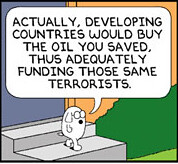
Dogbert: Actually, developing countries would buy the oil you saved, thus adequately funding those same terrorists.
Dilbert: At least I wouldn't be funding them myself.
Dogbert: Actually money is a fungible commodity. The capitalist system virtually guarantees that you'll end up buying the lowest cost oil from sources unknown to you.
Dilbert: Well, maybe, but I want my car to make a statement.
Dogbert: And the statement would be "Hey, everyone, I don't know what fungible means!"
I will spot Adams it being a truism that you can't avoid buying oil from a certain source if they're all selling to a common pool of middlemen (hence, the word "commodity" is all important. The word "fungible," meaning exchangeable or replaceable, applies to oil to a considerable degree, both in terms of it being convertible to other energy and materials sources, and to a deficit in one energy source being made up by another, but it's not nearly as fungible as, say, money, whose only raison d'etre is fungibility. Any product - here, a resource - which is sold as a pooled commodity through the same middlemen is indeed impossible to separate out as a purchaser - one reason "voting with your dollars" can NEVER be a complete solution to social problems. By the way, Libyan sweet crude is not exchanged for lower quality Saudi oil, both are sold to brokers and thence to refiners, unless the refiners own the oil, and the entire production is blended in the market).
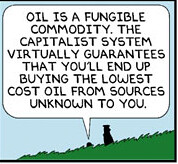
Step back and look at what Adams is saying: That if the United States didn't buy foreign oil, it wouldn't make the least bit of difference to the "countries that hate us" (many of which the American government call our allies) that "fund terrorists" (presumably including the US, an oil producing nation which funded terrorism in Cuba and Nicaragua and directly and through aid to Pakistan funded the Taliban and Al Qaeda). Beyond doubt, oil being the most useful form of energy now in existence, it's not like people will follow the lead of the US if it gives up oil. But how many people with even a high-school knowledge of economics believe that if the United States went from being the premier consumer of MidEast oil (let's assume that's what Adams means) to being a total nonconsumer, that the profits flowing into net oil-exporting nations wouldn't change? Or the implication that the countries that hate us pretty much openly have this fund earmarked "Terrorism" and it has budgetary needs that are open and easy to discern, and that funding this budgetary item would swim right along even if the demand for oil from the American side went down drastically or ceased altogether? In point of fact, Al Qaeda wants to overthrow the House of Saud and Hosni Mubarak and was trying to bring down Saddam Hussein. The terrorists get their money mostly through blackmail and kidnapping, although some of the spoiled members of the ruling class do kick in voluntarily out of their own enormous fortunes.
Taking for granted what Adams is assuming, that oil is bought on a market by actors in various nations, clearly it's being allocated on a supply and demand basis (of course, that's simplistic with a limited resource overseen by cartels, often pre-bought on long-year terms by refiners, etc. etc., but it's clearly what Adams means - and thinks other people don't understand). There must be some good reason why China, for instance, doesn't simply outbid the United States every time, whatever it takes, and use every drop pumped out of the MidEast every year. Of course, the truth is that the supply of oil can't increase forever, and the demand looks more robust than the supply, so prices should indeed rise over time. Therefore, if the natural increase is enough to offset the lack of the current greatest source of demand, then profits should indeed be adequate for "the nations that hate us to fund terrorists." Of course, if there's US demand that's equal to or greater than current demand, that will simply increase the profits of the evil nations all the more. That's the flip side of a commodity market, and the part Adams is too stupid to grasp. While you can't reduce the profits of a point net exporter of oil, (it's similar to the idea that you can "spot reduce" through exercise), by reducing overall demand (and again, what Adams is too moronic to grasp is that a more fuel-efficient car performs the same economic activities the less fuel-efficient car performed, so there's no competitive advantage to China, India, etc. from the loss of demand on the American side).
A more fuel-efficient car makes many statements - you believe in and understand science, including climatology and thermodynamics, at least enough to reap their benefits. You understand basic microeconomics and perhaps macroeconomics enough not to be holding to a ludicrous position on fuel usage. Clearly, nations that are more energy efficient will have a huge advantage over those that aren't, including selling the ability to be that way to them. Energy efficiency, really, IS economic efficiency, or close enough, since the bottom line of economic efficiency is maximum profit from a set pool of resources.
But I am going out on a limb here not just because this is so much hand-waving by Adams (yes, it's just a cartoon, but his success as a cartoonist has led Adams to try his hand at punditry and that makes his "reasoning" fair game wherever it manifests).
In the second part of this post, I will point out that what Adams is saying here directly contradicts something he maintained in The Dilbert Future, which managed to err just as strongly but in the dead opposite direction. Here, he suggests demand is inelastic and always higher than supply for oil and that any actor who reduces will be like a person hauling a boat out of the water - it will just close in over where the boat was, leaving no trace.
He maintained QUITE ANOTHER REALITY when it comes to Draconian statutes such as the "three strikes" laws, as you'll see. I'll wrap up by explaining why an ultrarich, ultrasuccessful cartoonist can still be EITHER a moron or a liar talking about economics.
Sunday's color Dilbert:
Dilbert: I'm thinking about buying a more fuel efficient car.
Dogbert: Why?
Dilbert: It's my patriotic duty to reduce this country's dependence on foreign sources of oil.
Dogbert: Why?
Dilbert: Because then the countries that hate us will have less money to fund terrorists.
Dogbert: Actually, developing countries would buy the oil you saved, thus adequately funding those same terrorists.
Dilbert: At least I wouldn't be funding them myself.
Dogbert: Actually money is a fungible commodity. The capitalist system virtually guarantees that you'll end up buying the lowest cost oil from sources unknown to you.
Dilbert: Well, maybe, but I want my car to make a statement.
Dogbert: And the statement would be "Hey, everyone, I don't know what fungible means!"
I will spot Adams it being a truism that you can't avoid buying oil from a certain source if they're all selling to a common pool of middlemen (hence, the word "commodity" is all important. The word "fungible," meaning exchangeable or replaceable, applies to oil to a considerable degree, both in terms of it being convertible to other energy and materials sources, and to a deficit in one energy source being made up by another, but it's not nearly as fungible as, say, money, whose only raison d'etre is fungibility. Any product - here, a resource - which is sold as a pooled commodity through the same middlemen is indeed impossible to separate out as a purchaser - one reason "voting with your dollars" can NEVER be a complete solution to social problems. By the way, Libyan sweet crude is not exchanged for lower quality Saudi oil, both are sold to brokers and thence to refiners, unless the refiners own the oil, and the entire production is blended in the market).
Step back and look at what Adams is saying: That if the United States didn't buy foreign oil, it wouldn't make the least bit of difference to the "countries that hate us" (many of which the American government call our allies) that "fund terrorists" (presumably including the US, an oil producing nation which funded terrorism in Cuba and Nicaragua and directly and through aid to Pakistan funded the Taliban and Al Qaeda). Beyond doubt, oil being the most useful form of energy now in existence, it's not like people will follow the lead of the US if it gives up oil. But how many people with even a high-school knowledge of economics believe that if the United States went from being the premier consumer of MidEast oil (let's assume that's what Adams means) to being a total nonconsumer, that the profits flowing into net oil-exporting nations wouldn't change? Or the implication that the countries that hate us pretty much openly have this fund earmarked "Terrorism" and it has budgetary needs that are open and easy to discern, and that funding this budgetary item would swim right along even if the demand for oil from the American side went down drastically or ceased altogether? In point of fact, Al Qaeda wants to overthrow the House of Saud and Hosni Mubarak and was trying to bring down Saddam Hussein. The terrorists get their money mostly through blackmail and kidnapping, although some of the spoiled members of the ruling class do kick in voluntarily out of their own enormous fortunes.
Taking for granted what Adams is assuming, that oil is bought on a market by actors in various nations, clearly it's being allocated on a supply and demand basis (of course, that's simplistic with a limited resource overseen by cartels, often pre-bought on long-year terms by refiners, etc. etc., but it's clearly what Adams means - and thinks other people don't understand). There must be some good reason why China, for instance, doesn't simply outbid the United States every time, whatever it takes, and use every drop pumped out of the MidEast every year. Of course, the truth is that the supply of oil can't increase forever, and the demand looks more robust than the supply, so prices should indeed rise over time. Therefore, if the natural increase is enough to offset the lack of the current greatest source of demand, then profits should indeed be adequate for "the nations that hate us to fund terrorists." Of course, if there's US demand that's equal to or greater than current demand, that will simply increase the profits of the evil nations all the more. That's the flip side of a commodity market, and the part Adams is too stupid to grasp. While you can't reduce the profits of a point net exporter of oil, (it's similar to the idea that you can "spot reduce" through exercise), by reducing overall demand (and again, what Adams is too moronic to grasp is that a more fuel-efficient car performs the same economic activities the less fuel-efficient car performed, so there's no competitive advantage to China, India, etc. from the loss of demand on the American side).
A more fuel-efficient car makes many statements - you believe in and understand science, including climatology and thermodynamics, at least enough to reap their benefits. You understand basic microeconomics and perhaps macroeconomics enough not to be holding to a ludicrous position on fuel usage. Clearly, nations that are more energy efficient will have a huge advantage over those that aren't, including selling the ability to be that way to them. Energy efficiency, really, IS economic efficiency, or close enough, since the bottom line of economic efficiency is maximum profit from a set pool of resources.
But I am going out on a limb here not just because this is so much hand-waving by Adams (yes, it's just a cartoon, but his success as a cartoonist has led Adams to try his hand at punditry and that makes his "reasoning" fair game wherever it manifests).
In the second part of this post, I will point out that what Adams is saying here directly contradicts something he maintained in The Dilbert Future, which managed to err just as strongly but in the dead opposite direction. Here, he suggests demand is inelastic and always higher than supply for oil and that any actor who reduces will be like a person hauling a boat out of the water - it will just close in over where the boat was, leaving no trace.
He maintained QUITE ANOTHER REALITY when it comes to Draconian statutes such as the "three strikes" laws, as you'll see. I'll wrap up by explaining why an ultrarich, ultrasuccessful cartoonist can still be EITHER a moron or a liar talking about economics.
Quick note on editing
I post very rapidly, hence the long sentences and lack of links. As I get the ambition, i go back and put links in, but I rarely see a justification for making my weblog posts more readable. Usually, even for a "timeless" specialty blog, events have moved on, or I have. If anything, I simply resolve to get closer to inverted pyramid style.
The long rambling sentences will probably stay, but I will try to provide hypertext link context for all the concepts, names and events I refer to. and I'll try to make the first rambling sentence count, so busy people won't have any need to read the rest.
I have some experience as a workaday reporter, both daily and weekly, in both print and radio, and I wouldn't turn these weblog posts in as stories or even op-eds, and I wouldn't collect them in a book, either, without rewriting every one of them.
The long rambling sentences will probably stay, but I will try to provide hypertext link context for all the concepts, names and events I refer to. and I'll try to make the first rambling sentence count, so busy people won't have any need to read the rest.
I have some experience as a workaday reporter, both daily and weekly, in both print and radio, and I wouldn't turn these weblog posts in as stories or even op-eds, and I wouldn't collect them in a book, either, without rewriting every one of them.
A limited defense of religious faith
The Libertarian mantra of "fiscally conservative, socially liberal", which is false on both accounts - viz. the "socially liberal" defense of the right of the Klan and Nazis to march through Skokie* or the "fiscally conservative" idea that even if you can get more for your money with some social spending and foreign aid in terms of domestic tranquility and peace abroad, the objective of cops, courts and the military, it's always unacceptable, whereas spending your society into a hole you'll have to tax yourself out of someday on corrupt military contracts and excessive cop and court facilities because Big Business wants it is mandatory, has infected the Democrats, liberals and progressives of America.
One of the things we can all agree on, as we bash Islam across the world, as we hunt through the Quran and hadith and the rantings of the worst representatives of the Moslem faith we can possibly find, ignoring the glorification of genocide, bizarrely violent and stupid customs and folk beliefs, and paradigm xenophobia, racism and religious bigotry you can find in the Torah, Talmud, disregarding the psychotically bigoted HaTanya, ignoring the writings of the founder of Lutheranism, ignoring centuries of hate-filled edicts from the Catholic Church, and so on, and the history of American Protestant fanaticism from the witch hangings through the Great Awakening up to our present theocracy, one thing we can agree on is that it does not matter because, really, "all religion is the problem."
First of all, I suspect that's often a dodge to hide Judeo-Christian chauvinism, given the polls that show a large majority of Americans - 80-85% at least - are believing Christians or Jews. But that obvious observation aside, let me address those who do think religion is the problem, and perhaps the only thing wrong with Islam is that it takes itself seriously or is extreme or has too low a component of science or is just against Western progress because it's Western. Or something like that.
First of all, the implication that religion or religious faith are of no value I find completely dubious. On balance, it may even make people act better as individuals than they'd be otherwise, and when they act badly as a group, frankly, it's usually mixed in with the usual power and resource games. But even taking religion as a break even thing, there is a tremendous value to the religious perspective.
Since this is, unapologetically, a Science Fiction Weblog, I will cite the Dune series as embodying the concepts here. On the one hand, the various faiths had been synthesized into new shapes (Buddislamists, Zensunnis, and the Orange Catholic faith, which included Catholic, Orthodox, Protestant, Judaic and Islamic elements), in the case of Buddhislam and Zensunnism, as a way of creating new ethnic enclaves and social cohesion. In the case of the Orange Catholic faith, it was spread by a Missionaria Protectiva controlled by the Bene Gesserit (Well-doers) to seed the various planets with preset religious memes and prophecies that would protect the dominant imperial culture in advance. That, of course, is classical missionary behavior, and the classic function of missionaries of the approved state faith in an imperium.
On the other hand, all of humanity owed its freedom, literally, and probably its existence, to the early crude efforts at a Missionaria Protectiva. The Butlerian Jihad, and I wonder if it's a coincidence that Herbert's is the 2nd such crusade - the first was in Samuel Butler's Erewhon, on behalf of humans against "self-willed" machines - had at its core a rigid division between human and inhuman, and more importantly, between living and dead. Conscious and unconscious. Really aware, and faking it. Because of the fanaticism of faith, the recognition that you have to take at least a few starting ideas as givens and not deconstruct every element of morality, reality and learning, humanity prevailed against machines pretending to be alive, conscious and superior, and their lackeys, who were mostly machine but with human brains. I think that's believable - that you couldn't have gotten a gaggle of Libertarian capitalist rationalist corporatists to go fight the machines. Okay, believable is kind of an understatement here.
I find a lot of the "liberal heroes" of anti-religion really repellent. In particular, people like James Randi, Penn Jillette, Richard Dawkins, Daniel Dennet offend me with their simplistic pseudoscientific style of talking about society, reality, philosophy and religion. Dennett's main contribution so far is a compilation called the Mind's I. I think John Searle simply killed the thrust of that - that there really is no distinction between a human mind and a pattern in a book or a good computer program. You should look up Searle's Chinese Room for the details. I would also point out that Hume was the originator of the notion that the self and awareness are not primary and not even real. Or not as real as a good piece of engineering. And Hume's philosophical goal was justifying the rule of the elites, as Thom Hartmann has pointed out.
I will give Dawkins credit for being a real scientist (I suspect Randi and Jillette of being almost complete scientific ignoramuses, from some of the things they've said about science and the scientific method). And some credit for introducing revolutionary ideas like memes into the language and culture. But the thing about calling yourself a "Bright" is pretty good evidence that Dawkins sucks at relating to actual hominids running around. Sagan, similarly rigid in his anti-religious crusade, would never have made that mistake.
Not long ago, a lot of high-tech moguls from places like Sun and Oracle met to discuss - well - machines taking over and replacing people, and how that was a genuine threat, maybe not in our lifetime but in that of our children or grand-children.
We already are under assault by inhuman entities, not conscious but pretending to be, like the Chinese Room, things that want to displace people, enslave them, destroy them, humble them wherever possible. And they have allies who are making themselves as inhuman as possible. They're called corporations.
More on this later.
*For the record, I support the ACLU, I support the right of people to engage in hateful speech, and I am against hate-crime laws. I just don't claim that that's "socially liberal." It's socially "laissez-faire," but it's balancing absolute rights against the right of people to go about their lives not living in fear and not being hindered by harassment. We can't advocate - really, talk about - assassinating the president because that involves preparing the ground for undermining our democracy. We can't issue death threats (to a degree), because they're reasonably often enough a precursor to violence, so they justify at least putting people under scrutiny and in some cases, punishing them. It's a good question whether Alan Berg would be alive today if the death threats he got had been followed up by legal action. It's not clear enough that the answer is "yes" to make me want to go beyond our current balancing act.
One of the things we can all agree on, as we bash Islam across the world, as we hunt through the Quran and hadith and the rantings of the worst representatives of the Moslem faith we can possibly find, ignoring the glorification of genocide, bizarrely violent and stupid customs and folk beliefs, and paradigm xenophobia, racism and religious bigotry you can find in the Torah, Talmud, disregarding the psychotically bigoted HaTanya, ignoring the writings of the founder of Lutheranism, ignoring centuries of hate-filled edicts from the Catholic Church, and so on, and the history of American Protestant fanaticism from the witch hangings through the Great Awakening up to our present theocracy, one thing we can agree on is that it does not matter because, really, "all religion is the problem."
First of all, I suspect that's often a dodge to hide Judeo-Christian chauvinism, given the polls that show a large majority of Americans - 80-85% at least - are believing Christians or Jews. But that obvious observation aside, let me address those who do think religion is the problem, and perhaps the only thing wrong with Islam is that it takes itself seriously or is extreme or has too low a component of science or is just against Western progress because it's Western. Or something like that.
First of all, the implication that religion or religious faith are of no value I find completely dubious. On balance, it may even make people act better as individuals than they'd be otherwise, and when they act badly as a group, frankly, it's usually mixed in with the usual power and resource games. But even taking religion as a break even thing, there is a tremendous value to the religious perspective.
Since this is, unapologetically, a Science Fiction Weblog, I will cite the Dune series as embodying the concepts here. On the one hand, the various faiths had been synthesized into new shapes (Buddislamists, Zensunnis, and the Orange Catholic faith, which included Catholic, Orthodox, Protestant, Judaic and Islamic elements), in the case of Buddhislam and Zensunnism, as a way of creating new ethnic enclaves and social cohesion. In the case of the Orange Catholic faith, it was spread by a Missionaria Protectiva controlled by the Bene Gesserit (Well-doers) to seed the various planets with preset religious memes and prophecies that would protect the dominant imperial culture in advance. That, of course, is classical missionary behavior, and the classic function of missionaries of the approved state faith in an imperium.
On the other hand, all of humanity owed its freedom, literally, and probably its existence, to the early crude efforts at a Missionaria Protectiva. The Butlerian Jihad, and I wonder if it's a coincidence that Herbert's is the 2nd such crusade - the first was in Samuel Butler's Erewhon, on behalf of humans against "self-willed" machines - had at its core a rigid division between human and inhuman, and more importantly, between living and dead. Conscious and unconscious. Really aware, and faking it. Because of the fanaticism of faith, the recognition that you have to take at least a few starting ideas as givens and not deconstruct every element of morality, reality and learning, humanity prevailed against machines pretending to be alive, conscious and superior, and their lackeys, who were mostly machine but with human brains. I think that's believable - that you couldn't have gotten a gaggle of Libertarian capitalist rationalist corporatists to go fight the machines. Okay, believable is kind of an understatement here.
I find a lot of the "liberal heroes" of anti-religion really repellent. In particular, people like James Randi, Penn Jillette, Richard Dawkins, Daniel Dennet offend me with their simplistic pseudoscientific style of talking about society, reality, philosophy and religion. Dennett's main contribution so far is a compilation called the Mind's I. I think John Searle simply killed the thrust of that - that there really is no distinction between a human mind and a pattern in a book or a good computer program. You should look up Searle's Chinese Room for the details. I would also point out that Hume was the originator of the notion that the self and awareness are not primary and not even real. Or not as real as a good piece of engineering. And Hume's philosophical goal was justifying the rule of the elites, as Thom Hartmann has pointed out.
I will give Dawkins credit for being a real scientist (I suspect Randi and Jillette of being almost complete scientific ignoramuses, from some of the things they've said about science and the scientific method). And some credit for introducing revolutionary ideas like memes into the language and culture. But the thing about calling yourself a "Bright" is pretty good evidence that Dawkins sucks at relating to actual hominids running around. Sagan, similarly rigid in his anti-religious crusade, would never have made that mistake.
Not long ago, a lot of high-tech moguls from places like Sun and Oracle met to discuss - well - machines taking over and replacing people, and how that was a genuine threat, maybe not in our lifetime but in that of our children or grand-children.
We already are under assault by inhuman entities, not conscious but pretending to be, like the Chinese Room, things that want to displace people, enslave them, destroy them, humble them wherever possible. And they have allies who are making themselves as inhuman as possible. They're called corporations.
*For the record, I support the ACLU, I support the right of people to engage in hateful speech, and I am against hate-crime laws. I just don't claim that that's "socially liberal." It's socially "laissez-faire," but it's balancing absolute rights against the right of people to go about their lives not living in fear and not being hindered by harassment. We can't advocate - really, talk about - assassinating the president because that involves preparing the ground for undermining our democracy. We can't issue death threats (to a degree), because they're reasonably often enough a precursor to violence, so they justify at least putting people under scrutiny and in some cases, punishing them. It's a good question whether Alan Berg would be alive today if the death threats he got had been followed up by legal action. It's not clear enough that the answer is "yes" to make me want to go beyond our current balancing act.
Friday, February 17, 2006
all morons left or right bashing islam over protests: sorry, no love
[Follow-up, 19/02/2006: The genuinely violent and murderous rioting in Nigeria, which involved violence by the protesters, including the death by immolation of a Christian victim, appears to have been mainly over the rumor that born-again Christian president Olusegun Obasanjo would violate Nigerian law and run for a third term. While religious strife plays a part in Nigeria, the main causes of civil violence there are tribal politics and corruption. Hence, the Western media and anti-democratic rightists like Michelle Malkin are wrong to call this "cartoon rioting" when it was not, mainly. On the other hand, many Moslem groups have called for censorship laws in Denmark which the Danish government should resist completely, and that is, indeed, a call for censorship, and to the degree that they tie it to violent protests, it's calling for the heckler's or mob veto on free speech. None of this weakens the thrust of my argument by very much. As someone who reads and speaks Danish, I follow Danish media a bit, and I have to say, while most people like me read things like Politiken, not tabloids like Ekstra Bladet or Washington Timesian pseudopapers like Jyllands-Posten (ironically, all 3 now owned by the same company!) I haven't certainly read enough of Jyllandsposten to find editorials against free speech, but in its earliest incarnation it supported Mussolini's clamp-down and the Kristallnacht against Jewish businesses and homes.]
On this, the World Socialist Web Site is the only place showing any signs of sanity.
You're siding with those US puppets and allies who SHOOT DOWN PROTESTERS and calling THAT freedom, and you're calling the protests and riots against racist propaganda from a pro-Nazi tabloid CENSORSHIP. Imperialism has warped your values that far. And that cultural rot is the main reason I am doing this weblog. Science fiction is simply a not-covered topic, but I'll have other analyses here - the cultural tropes that serve today's optimates are everywhere.
and
On this, the World Socialist Web Site is the only place showing any signs of sanity.
You're siding with those US puppets and allies who SHOOT DOWN PROTESTERS and calling THAT freedom, and you're calling the protests and riots against racist propaganda from a pro-Nazi tabloid CENSORSHIP. Imperialism has warped your values that far. And that cultural rot is the main reason I am doing this weblog. Science fiction is simply a not-covered topic, but I'll have other analyses here - the cultural tropes that serve today's optimates are everywhere.
A campaign is emerging to depict Islam as an inferior culture that is incompatible with “Western values.” There are clear parallels here to the anti-Semitic caricatures that were spread in the 1930s by fascist newspapers such as the Nazi Stürmer. The depiction of Jews as sub-humans served as the ideological preparation for the Holocaust.
Today the systematic defamation of Muslims is being used to prepare public opinion for new wars against countries such as Iran and Syria—wars which will be even more brutal than the Iraq war, and could well involve the use of nuclear weapons.
It is no coincidence that it was the Jyllands-Posten that took up this initiative. The newspaper is notorious for its declarations of support for the Nazis in the 1930s, and has played a key role in Denmark’s recent shift to the right.
With editorial offices in the rural area of Arhus, Jyllands-Posten remained a relatively insignificant provincial newspaper until the beginning of the 1980s. At that time it began an aggressive policy of expansion. It bought up smaller regional and local newspapers and launched a price war with the two established newspapers in the Danish capital—Berlingske Tidende and Politiken—and rapidly built up its circulation to 170,000, becoming the biggest circulation newspaper in the country.
In the 1990s the decidedly conservative paper increasingly developed into a mouthpiece for openly xenophobic, right-wing forces. Nearly a quarter of the editorial board was dismissed, and the quality of the paper sank as its aggressiveness rose.
Shortly before the publication of the Muhammad cartoons, Jyllands-Posten ran a headline reading, “Islam is the Most Belligerent.” The newspaper ran an exposé about an alleged Muslim death-list of Jewish names—until it emerged that the whole thing was a fabrication.
One year ago the editor-in-chief resigned because the newspaper carried a report, in the midst of an election campaign, alleging the systematic abuse of welfare rights by asylum-seekers. The sensational charges were published against his will
and
It is noteworthy that those who have rallied to the defense of the right-wing anti-immigrant newspaper in Denmark that first published the racist cartoons have had little to say about the violence of repressive governments across the Middle East against their own people registering outrage over the widely disseminated insult to their religion.
These ostensible defenders of press freedom instinctively sympathize with the regime of Hamid Karzai in Afghanistan, which “defended freedom” by shooting down seven demonstrators. Other deaths were reported in Lebanon, Turkey and Somalia. All but one of those killed were Muslim protesters.
Friday, February 10, 2006
I have a terminal case of "Evil Republican Nostalgia!"
Admit it, we've all caught it by now. We look back fondly to Ike (who cut his spurs trampling sick, starving crippled veterans begging for the wherewithal, their promised Bonuses, to continue living and feed their families. Who overthrew numerous democracies and installed murder regimes all over the world. Who pledged an unlimited American commitment to preventing Vietnamese independence, including whatever troops would be needed, a blank check that even included the use of nuclear weapons if necessary). We take one look at the Bush administration, and suddenly Eisenhower is washed in the blood of the Lamb, all his sins cleansed, all the stains made pure.
But it doesn't stop there. Goldwater, now, there was a man of principle - not a lackey of the fundie right. A man with the courage to go to Nixon and say it was time to resign. Also, a man who ACTUALLY crafted "Nixon's" Southern strategy AND Reagan's fascist alliance of theocrats and economic royalists. A man who also wanted to use nuclear weapons on the Vietnamese, and on several other peoples. A man who spread arrant nonsense like "Give Red China our UN seat" and "a Republic, not a Democracy" - what Janeane Garofalo has rightly labeled "raw meat for the dopes." Clearly, nonetheless, he'd be too competent, sane and reasonable even to work in Bush's cabinet.
As for Nixon, well, he did have the Huston plan, COINTELPRO, blatant treason in 1968 in Vietnam, a history of ruining lives in the witch-hunts of the 50s, and a complete disregard for the law. But he also went to China, brokered a peace treaty in Vietnam and the beginnings of one in the MidEast, started detente with Russia and created (read, didn't veto) the EPA and put in "liberal" wage and price controls*. And he certainly leveled with the American people in a way W never would do. Nixon was heckled during his entire presidency. W just has people put behind barbed wire everywhere he goes, and for the most part, his feet don't touch the ground. Yes, admit it, we miss Nixon. We'd give our pinkies at least - and our comic book collection - to have Nixon back as president.
Which leads us inevitably to Reagan. One of the most evil and dishonest figures in American history. Pioneered the "vote for me, I'm stupid and mean like you" strategy for turning out the vote. A successful Goldwater with a 10th the brains and integrity. While Nixon and Johnson both put serious dents in the fiscal soundness of the United States, Reagan is the one who decided at some point the economy had to be trashed, so why not be the one to do it, and benefit from it? He stole Nikita Kruschev's thunder by burying America before the pathetic Soviets could. He also joined Nixon in the ranks of private citizens who rode blatant acts of treason to the White House, and didn't stop there, arming everyone from Al Qaida, Saddam Hussein, Islamic Jihad and Hezbollah to Somoza's blackshirts and the Idi Amin-like deathsquadocracy that was El Salvador. He inspired the most massive popular protests against any president in history up to that point, by ordinary Americans, not just hippies and radicals, and never obtained more than a mediocre popularity in 8 years in office, depending solely on the skills of his legions of hate mongers and demonizers to triumph through 100% dependence on the politics of personal destruction. But Reagan at least looked sharp and didn't talk (most of the time) as if he needed residential care and a tutor. He concluded fairly serious agreements with Gorbachev and had the good sense to raise taxes nearly every year (payroll taxes first, then income taxes) to make up for his poisonous and fiscally insane tax cuts for the rich that he'd promised them to get enough bribes to float into office. Yes, we miss the Gipper. God help us all.
And I don't even feel bad about missing Bush pere. I mean, left the NRA and said trying to hold Iraq was for morons. Sure, he was a CIA villain of long antiquity, a fake Texan who rode racism into office and was the hands-on man for Reagan's treason. But most of the time, however spacily and with whatever tortured syntax, once you'd parsed a Bush Sr. utterance it usually bore some semblance of a relationship to reality. It's not for nothing that Bush Sr. and his associates are usually referred to as "grownups" in the media. Which only highlights the fact that "grownups" are not what Americans got for their votes or at least the ones that counted. Most of us would CAMPAIGN for Bush Sr. against Jr. if it came to that.
Okay, I am babbling on and on on something that's common knowledge - Bush makes all previous Republican villains look like "Saints and Scholars." But I did all this as a preamble to a really embarrassing secret:
I AM IN FACT NOSTALGIC FOR THE FIRST GEORGE W. BUSH ADMINISTRATION TERM.
Yes, it's true. I didn't think we could possibly do worse than Cheney's energy scam, 9/11, the clinically, religiously insane John Ashcroft who ordered our national police to ignore terrorism and hunt down prostitutes and marijuana paraphernalia, our brutal emulation of the Soviets in Afghanistan, Hitlerian aggression against Iraq, the Mouth of Sauron, Ari Fleischer, the comic-villain-Count Cagliostro/Fu Manchu figure of Don Rumsfeld, etc. etc.
But we have, haven't we? At least theoretically, we're gearing up to tell Iran and Syria to bring it on. We got rid of Ari and got Scott, which is like being exorcised of a horde of minor imps and getting repossessed by Asmodeus. We got rid of Honest Stupid John Assclown and got a figure right out of Rise and Fall of the Third Reich - Alberto Gonzales - a degenerate hybrid of John Negroponte and - well, and Ari Fleischer. Or Joseph Goebbels. Or Felix Dzerzhezhinsky.
We now have Condaleeza Rice embarrassing us EVERY SINGLE DAY somewhere in the world. John Bolton peeing in the flower pot of the Egyptian ambassador. And somewhere along the way, the GOP decided to drop the figleaf of Rule of Law and declare themselves The Party and the United States a "moderately authoritarian" semi-military kleptocracy just like the ones Dad used to install.
And W himself has become more insufferable, not just every year but every single day. He's reached a critical mass of evil - giving off cancerous rays that wither and destroy everything living within a 100 square mile area around him and promising a devastating and disastrous blowup anytime now.
So there you have it - my Evil Republican Nostalgia Syndrome (ERNS) is terminal. I can't see it going anywhere good from this point. I'll probably look for the political equivalent of Laetrile or monkey glands at this point, as desperation sets in. But if anyone else out there is as bad off as I am, perhaps this will at least serve to let them know they're not alone. So cheer up, already!
*Nixon 's economic policies were nothing to his credit for the most part, but the principle that the government can intervene in the economy BEFORE things become utterly disastrous is a very important one, and Nixon was reinforcing that principle.
But it doesn't stop there. Goldwater, now, there was a man of principle - not a lackey of the fundie right. A man with the courage to go to Nixon and say it was time to resign. Also, a man who ACTUALLY crafted "Nixon's" Southern strategy AND Reagan's fascist alliance of theocrats and economic royalists. A man who also wanted to use nuclear weapons on the Vietnamese, and on several other peoples. A man who spread arrant nonsense like "Give Red China our UN seat" and "a Republic, not a Democracy" - what Janeane Garofalo has rightly labeled "raw meat for the dopes." Clearly, nonetheless, he'd be too competent, sane and reasonable even to work in Bush's cabinet.
As for Nixon, well, he did have the Huston plan, COINTELPRO, blatant treason in 1968 in Vietnam, a history of ruining lives in the witch-hunts of the 50s, and a complete disregard for the law. But he also went to China, brokered a peace treaty in Vietnam and the beginnings of one in the MidEast, started detente with Russia and created (read, didn't veto) the EPA and put in "liberal" wage and price controls*. And he certainly leveled with the American people in a way W never would do. Nixon was heckled during his entire presidency. W just has people put behind barbed wire everywhere he goes, and for the most part, his feet don't touch the ground. Yes, admit it, we miss Nixon. We'd give our pinkies at least - and our comic book collection - to have Nixon back as president.
Which leads us inevitably to Reagan. One of the most evil and dishonest figures in American history. Pioneered the "vote for me, I'm stupid and mean like you" strategy for turning out the vote. A successful Goldwater with a 10th the brains and integrity. While Nixon and Johnson both put serious dents in the fiscal soundness of the United States, Reagan is the one who decided at some point the economy had to be trashed, so why not be the one to do it, and benefit from it? He stole Nikita Kruschev's thunder by burying America before the pathetic Soviets could. He also joined Nixon in the ranks of private citizens who rode blatant acts of treason to the White House, and didn't stop there, arming everyone from Al Qaida, Saddam Hussein, Islamic Jihad and Hezbollah to Somoza's blackshirts and the Idi Amin-like deathsquadocracy that was El Salvador. He inspired the most massive popular protests against any president in history up to that point, by ordinary Americans, not just hippies and radicals, and never obtained more than a mediocre popularity in 8 years in office, depending solely on the skills of his legions of hate mongers and demonizers to triumph through 100% dependence on the politics of personal destruction. But Reagan at least looked sharp and didn't talk (most of the time) as if he needed residential care and a tutor. He concluded fairly serious agreements with Gorbachev and had the good sense to raise taxes nearly every year (payroll taxes first, then income taxes) to make up for his poisonous and fiscally insane tax cuts for the rich that he'd promised them to get enough bribes to float into office. Yes, we miss the Gipper. God help us all.
And I don't even feel bad about missing Bush pere. I mean, left the NRA and said trying to hold Iraq was for morons. Sure, he was a CIA villain of long antiquity, a fake Texan who rode racism into office and was the hands-on man for Reagan's treason. But most of the time, however spacily and with whatever tortured syntax, once you'd parsed a Bush Sr. utterance it usually bore some semblance of a relationship to reality. It's not for nothing that Bush Sr. and his associates are usually referred to as "grownups" in the media. Which only highlights the fact that "grownups" are not what Americans got for their votes or at least the ones that counted. Most of us would CAMPAIGN for Bush Sr. against Jr. if it came to that.
Okay, I am babbling on and on on something that's common knowledge - Bush makes all previous Republican villains look like "Saints and Scholars." But I did all this as a preamble to a really embarrassing secret:
I AM IN FACT NOSTALGIC FOR THE FIRST GEORGE W. BUSH ADMINISTRATION TERM.
Yes, it's true. I didn't think we could possibly do worse than Cheney's energy scam, 9/11, the clinically, religiously insane John Ashcroft who ordered our national police to ignore terrorism and hunt down prostitutes and marijuana paraphernalia, our brutal emulation of the Soviets in Afghanistan, Hitlerian aggression against Iraq, the Mouth of Sauron, Ari Fleischer, the comic-villain-Count Cagliostro/Fu Manchu figure of Don Rumsfeld, etc. etc.
But we have, haven't we? At least theoretically, we're gearing up to tell Iran and Syria to bring it on. We got rid of Ari and got Scott, which is like being exorcised of a horde of minor imps and getting repossessed by Asmodeus. We got rid of Honest Stupid John Assclown and got a figure right out of Rise and Fall of the Third Reich - Alberto Gonzales - a degenerate hybrid of John Negroponte and - well, and Ari Fleischer. Or Joseph Goebbels. Or Felix Dzerzhezhinsky.
We now have Condaleeza Rice embarrassing us EVERY SINGLE DAY somewhere in the world. John Bolton peeing in the flower pot of the Egyptian ambassador. And somewhere along the way, the GOP decided to drop the figleaf of Rule of Law and declare themselves The Party and the United States a "moderately authoritarian" semi-military kleptocracy just like the ones Dad used to install.
And W himself has become more insufferable, not just every year but every single day. He's reached a critical mass of evil - giving off cancerous rays that wither and destroy everything living within a 100 square mile area around him and promising a devastating and disastrous blowup anytime now.
So there you have it - my Evil Republican Nostalgia Syndrome (ERNS) is terminal. I can't see it going anywhere good from this point. I'll probably look for the political equivalent of Laetrile or monkey glands at this point, as desperation sets in. But if anyone else out there is as bad off as I am, perhaps this will at least serve to let them know they're not alone. So cheer up, already!
*Nixon 's economic policies were nothing to his credit for the most part, but the principle that the government can intervene in the economy BEFORE things become utterly disastrous is a very important one, and Nixon was reinforcing that principle.
A short rebuttal to Hogan's malevolently stupid aphorism
Science really doesn't exist. Scientific beliefs are either proved wrong, or else they quickly become engineering. Everything else is untested speculation.
The thinking here is that engineering has to work, science can coast without being answerable to failure. Engineering is constrained by reality, science by nothing. Etc.
In the real world, engineers fail all the time. Hence deaths, lawsuits, holdups. They misjudge materials and conditions, cut corners, and have horrific failures every day.
Einstein's Special and General Theories of Relativity, claimed by Hogan to be false, on the other hand, have been tested exhaustively for almost a century now. They've never failed once.
Einstein's General Theory and Special Theory were tested by Gravity Probe A with respect to gravity and speed and time dilation to a tolerance of 70 parts per million, which is very comparable to the best engineering tolerance tests, and by the Cassini satellite test to 20 parts per million. As our measurements become more precise, these tests will only get better and better for relativity.
Generally, science provides more rigorous tests than engineering conditions or Nature can, but in the form of binary pulsar systems nature has provided a test of general relativity which is qualitative instead of quantitative - four different effects of general relativity were all observed. You can assign whatever arbitrarily high probability you wish to that, versus the speculations of the anti-relativity cranks.
Moreover, particle accelerators test relativity every day, unfailingly, so you can't say it's "science" that doesn't have to "fly."
Thursday, February 09, 2006
Quick overview and exception noted
As I diverge ever further and follow more and more by-paths, let me acknowledge that, amongst the market fundamentalism, fetishistic militarism, rank hatred of environmentalists and biologists, imperialist apologism and dismissal of the whole history of "inferior third world cultures", and all the other paraphrenalia, most modern US sci-fi writers have also embraced a limited subset of feminism, in the libertarianesque sense that women can do as much, or nearly, as men.
It's probably not coincidental that the one group they will acknowledge has had a tough time under traditional conservative values is women, given that they're the only "minority" numerous enough to help Republicans keep power. The Republicans Libertarians always support. Always. Despite their pretensions not to be the lap dogs of fundamentalists and reactionaries.
And the feminism I'm talking about is largely the Victorian "men are just dogs" style, a relic of an era when men were regarded as born morally deficient the way women were believed in Christendom to be in the Middle Ages. It's not challenging of patriarchical values (which are based, by the way, not on male dominance but on a mechanism for one tribe, race or religion to beat out another - most of the men driven out to fight and die, with enough left in charge to breed the next generation, and with enemy women and children either converted, enslaved, or exterminated). It's not looking at how "male chauvinism" ties into the capitalist/religious axis, the way Friedrich Engels did. It's "floating out in space" feminism.
And if you really believe "men are just dogs" and can't be expected to behave as well as women, that's very convenient as an excuse for all the closeted gay reactionaries and weekend swingers and adulterers and multiple spouses and sexual harrassment, and so on, isn't it? It might make someone female feel an ego boost to think they're born into the gender that's not "mean" and "piggish" and "oppressive," but it's actually of no help to them whatsoever. Indeed, it's partly a reaction to the resurgence of Victorian anti-male attitudes that drove some working class men to embrace Republicanism.
It's also not coincidental that this discovery of a limited feminist consciousness is occurring just when the fascist right wants us to go on more crusades and imperialist campaigns against the third world, with the Islamic nations as the ostensible target. Arundhati Roy has been content to simply mock this, because it's so absurd, but explanations count, too: Numerous modernizing third world leaders have been destroyed by the colonial powers, and chauvinistic and fascistic regimes put in their place. Women have certainly benefited from technological and social progress, but it's not been the Right that's made that possible, but the Left. Nor has Islam been a chauvinist drag on the societies where it's prominent, for the most part. In fact, they've usually been backward societies where it was a modernizing force. And when predominately Moslem nations have tried to raise up out of fundamentalism and tribalism (Nasser, Qasem, Mossadegh, Sukarno, etc. etc.), "the West" has always trampled them back down. Please recall the degreee to which our current regime courted the Taliban, and the campaign by Reaganites to promote Islamism all over the world to destabilize as many governments as possible.
Nonetheless, as I pointed out in praising Jerry Pournelle's moderate skeptical stance, and praising feminist leaders' comments on sexual harrassment during the Clinton impeachment, personalities and the paths and pressures that lead to results aren't all-important.
The simple fact is, women characters are getting more of a fair shake now in science fiction novels than, in my opinion, at any time in the past. Clearly, with science fiction being far to the right even of our corporate and militarist mass media in general, those women will be "Bush business wives" for the most part - exceptionally conservative, just as Blacks and hispanics must be to be included as people in the new paradigm. Nonetheless, it makes me interested in looking at the demographics and economics of science fiction - has the increase in female POV characters increased opportunity for female writers?
It's probably not coincidental that the one group they will acknowledge has had a tough time under traditional conservative values is women, given that they're the only "minority" numerous enough to help Republicans keep power. The Republicans Libertarians always support. Always. Despite their pretensions not to be the lap dogs of fundamentalists and reactionaries.
And the feminism I'm talking about is largely the Victorian "men are just dogs" style, a relic of an era when men were regarded as born morally deficient the way women were believed in Christendom to be in the Middle Ages. It's not challenging of patriarchical values (which are based, by the way, not on male dominance but on a mechanism for one tribe, race or religion to beat out another - most of the men driven out to fight and die, with enough left in charge to breed the next generation, and with enemy women and children either converted, enslaved, or exterminated). It's not looking at how "male chauvinism" ties into the capitalist/religious axis, the way Friedrich Engels did. It's "floating out in space" feminism.
And if you really believe "men are just dogs" and can't be expected to behave as well as women, that's very convenient as an excuse for all the closeted gay reactionaries and weekend swingers and adulterers and multiple spouses and sexual harrassment, and so on, isn't it? It might make someone female feel an ego boost to think they're born into the gender that's not "mean" and "piggish" and "oppressive," but it's actually of no help to them whatsoever. Indeed, it's partly a reaction to the resurgence of Victorian anti-male attitudes that drove some working class men to embrace Republicanism.
It's also not coincidental that this discovery of a limited feminist consciousness is occurring just when the fascist right wants us to go on more crusades and imperialist campaigns against the third world, with the Islamic nations as the ostensible target. Arundhati Roy has been content to simply mock this, because it's so absurd, but explanations count, too: Numerous modernizing third world leaders have been destroyed by the colonial powers, and chauvinistic and fascistic regimes put in their place. Women have certainly benefited from technological and social progress, but it's not been the Right that's made that possible, but the Left. Nor has Islam been a chauvinist drag on the societies where it's prominent, for the most part. In fact, they've usually been backward societies where it was a modernizing force. And when predominately Moslem nations have tried to raise up out of fundamentalism and tribalism (Nasser, Qasem, Mossadegh, Sukarno, etc. etc.), "the West" has always trampled them back down. Please recall the degreee to which our current regime courted the Taliban, and the campaign by Reaganites to promote Islamism all over the world to destabilize as many governments as possible.
Nonetheless, as I pointed out in praising Jerry Pournelle's moderate skeptical stance, and praising feminist leaders' comments on sexual harrassment during the Clinton impeachment, personalities and the paths and pressures that lead to results aren't all-important.
The simple fact is, women characters are getting more of a fair shake now in science fiction novels than, in my opinion, at any time in the past. Clearly, with science fiction being far to the right even of our corporate and militarist mass media in general, those women will be "Bush business wives" for the most part - exceptionally conservative, just as Blacks and hispanics must be to be included as people in the new paradigm. Nonetheless, it makes me interested in looking at the demographics and economics of science fiction - has the increase in female POV characters increased opportunity for female writers?
Tuesday, February 07, 2006
A Diversion: Jerry Pournelle on Hogan on Velikovsky
Hogan and Velikovsky
By the way, Pournelle wrote this in Spring 2000, and the site he lists, http://www.monadnock.net/fanspaces/hogan, is no longer current. To find similar content, go to jamesphogan.com, and in particular, http://www.jamesphogan.com/jphcommentarchive.shtml and search for everything to do with Velikovsky.
Anyone familiar with Pournelle at all will realize he's one of the people where the oar (wielded for market fundamentalist, economic royalist, and anti-environmentalist reasons) is stuck in at least once per book, and usually once per chapter. And he is definitely writing with friendliness and overall approval of his, on balance, quite conservative* fellow science fiction writer.
Yet, not having a "prove the Bible right" agenda, unlike Velikovsky and Hogan, in my estimation, he therefore also points out which are the strongest reasons for not believing Velikovsky, and he includes voluminous email correspondence including valuable links, from many different sources.
I especially like the end-position Pournelle takes. It's neither "my militia/crank/wingnut/crackpot/Millenarian belief system or it's UN One-World PC disinfo" nor is it the kind of sneering people like James Randi and Penn Jillette specialize in, nor is it formulaic skepticism of the kind exemplified by Martin Gardner and Doug Hofstadter of Scientific American.
I think Pournelle arrived there as a compromise between the harsh opposition he would give a non-science-fiction liberal academic with similar beliefs and showing the amity and support that many science fiction authors have for each other.
If I might make an analogy, many conservatives said feminists during the Clinton impeachment over Monica Lewinsky and, nominally, Paula Jones, suddenly took a much more reasonable attitude towards sexual harassment claims. While it's a fair "gotcha," it's not as important, in the long run, as the fact that so many did in fact arrive at a more rational formulation. I would add that history proved them, not their conservative critics right in the Anita Hill case, back when they were, admittedly, more unreasonable in general, and probably in the Paula Jones case as well. Sometimes the path and political pressures that lead someone to a more rational outlook shouldn't be dwelled upon. Rather, the embracing of reasonableness should be.
In the same vein, it's a pity people like Pournelle and his long-time co-writer Larry Niven couldn't be led to take this kind of thoughtful yet skeptical attitude toward the ideas of people who don't see eye to eye with them on nuclear waste, species extinction, the destruction of habitat, the non-supremacy of market fundamentalism, and a host of other issues. But clear thinking and reasonableness should be praised, not their absence somewhere else pointed out.
I called this link a "diversion," but in fact it replaces quite a lot I would have written about Velikovsky. Pournelle comes out, much as I have, rather close to Henry Bauer's take.
* Taking as examples only his latest posts, he opposes at least in retrospect the economic sanctions on Iraq, which is often a left, not even liberal position. On the other hand, he pushes the utterly false charge that the ACLU and American stores and perhaps George Soros were waging a war on Christmas (Limbaugh and O'Reilly were completely lying - there was no increase in ACLU-assisted suits against public displays of religion or use of public facilities for religious purposes. ACLU assistance to religious people wishing to enjoy the commons legally and constitutionally where there was no overarching establishment of a church but local officials thought there were, continued (and not just one case, as the War on Christmas liars claimed, but in fact, hundreds of such cases). Neither Target nor any other chain store ever told its employees not to say Merry Christmas. The town where they claimed Christmas colors were outlawed had not done so. Etc. He comments on one absurd judge who doesn't believe in punishment as if he were some kind of indicator or norm that a proper law-and-order policy was waning in American justice.
By the way, Pournelle wrote this in Spring 2000, and the site he lists, http://www.monadnock.net/fanspaces/hogan, is no longer current. To find similar content, go to jamesphogan.com, and in particular, http://www.jamesphogan.com/jphcommentarchive.shtml and search for everything to do with Velikovsky.
Anyone familiar with Pournelle at all will realize he's one of the people where the oar (wielded for market fundamentalist, economic royalist, and anti-environmentalist reasons) is stuck in at least once per book, and usually once per chapter. And he is definitely writing with friendliness and overall approval of his, on balance, quite conservative
Yet, not having a "prove the Bible right" agenda, unlike Velikovsky and Hogan, in my estimation, he therefore also points out which are the strongest reasons for not believing Velikovsky, and he includes voluminous email correspondence including valuable links, from many different sources.
I especially like the end-position Pournelle takes. It's neither "my militia/crank/wingnut/crackpot/Millenarian belief system or it's UN One-World PC disinfo" nor is it the kind of sneering people like James Randi and Penn Jillette specialize in, nor is it formulaic skepticism of the kind exemplified by Martin Gardner and Doug Hofstadter of Scientific American.
I think Pournelle arrived there as a compromise between the harsh opposition he would give a non-science-fiction liberal academic with similar beliefs and showing the amity and support that many science fiction authors have for each other.
If I might make an analogy, many conservatives said feminists during the Clinton impeachment over Monica Lewinsky and, nominally, Paula Jones, suddenly took a much more reasonable attitude towards sexual harassment claims. While it's a fair "gotcha," it's not as important, in the long run, as the fact that so many did in fact arrive at a more rational formulation. I would add that history proved them, not their conservative critics right in the Anita Hill case, back when they were, admittedly, more unreasonable in general, and probably in the Paula Jones case as well. Sometimes the path and political pressures that lead someone to a more rational outlook shouldn't be dwelled upon. Rather, the embracing of reasonableness should be.
In the same vein, it's a pity people like Pournelle and his long-time co-writer Larry Niven couldn't be led to take this kind of thoughtful yet skeptical attitude toward the ideas of people who don't see eye to eye with them on nuclear waste, species extinction, the destruction of habitat, the non-supremacy of market fundamentalism, and a host of other issues. But clear thinking and reasonableness should be praised, not their absence somewhere else pointed out.
I called this link a "diversion," but in fact it replaces quite a lot I would have written about Velikovsky. Pournelle comes out, much as I have, rather close to Henry Bauer's take.
Velikovsky One - Homework
Books I have read on the Velikovsky controversy:
- Worlds in Collision by Emmanuel Velikovsky
- Scientists Confront Velikovsky edited by Donald Goldsmith
- The Velikovsky Affair by Alfred DeGrazia
- Velikovsky Reconsidered by the editors of Pensee magazine
- Beyond Velikovsky by Henry Bauer
- Carl Sagan and Immanuel Velikovsky by Charles Ginenthal
- Scientific Literacy and The Myth of the Scientific Method by Henry Bauer
- The Structure of Scientific Revolutions by Thomas Kuhn
- Against Method by Paul Feyerabend
- Logic of Scientific Discovery by Karl Popper
- A Skeptical look at Karl Popper article by Scientific American's Martin Gardner
Dipping the non-economic oar in: James Hogan's "Kicking the Sacred Cow"
You can see excerpts of this book, Kicking the Sacred Cow by James P. Hogan, online, and for that reason I will, with one exception, only seriously discuss the excerpted chapters. I feel it's largely subsumed in The Politically Incorrect Guide to Science by Tom Bethell, but since Chris Mooney and John Farrell are already analyzing that book, I will make the beginnings of an analysis of Hogan's book, since his only claim to fame is as a relatively popular and successful science fiction author (known mainly for the Giants series), and hence, falls into the area this specialty weblog encompasses.
Both the author's starting statement:
My summary would be quite different from Hogan's wannabe aphorism* above. I would say his two actual epistemological rules are (1) The more Biblical theory is always right and (2) the crank is always right. Nothing much else could really explain such a tendentious and one-sided analysis of science.
How this fits into this weblog's specialty: Both Ecco (commenting on 14 signs of fascism in general) and Britt (trying them on for size in the United States of the current era) note the assault on science by the fascist system in favor of traditionalism, theocracy, and corporate interests. Most of my emphasis will be on the "corporate interests" part, but I thought I would start off with one that's mostly traditional and theocratic.
As a background, recently the author has written fiction defending and retelling† Velikovsky's "worlds in collision" theory, so I will start with Hogan's defense of Velikovsky, in my very next post. It's not excerpted in the online preview, but it is in his fiction books, and his comments in various places on the internet.
* The construction of which is a trait he shares with Robert Heinlein, who's the patron saint of science fiction conservatives.
† Much as Orson Scott Card has done with Mormon theology and cosmology. But Card is much more open about promoting Scriptural beliefs about reality as he sees them than Hogan is. Hogan is a committed "back-door" attacker of science, more like the people in the Discovery Institute.
Both the author's starting statement:
Science really doesn't exist. Scientific beliefs are either proved wrong, or else they quickly become engineering. Everything else is untested speculation.And the contents:
- Humanistic Religion: The Rush to Embrace Darwinism
- Of Bangs and Braids: Cosmology's Mathematical Abstractions
- Drifting in the Ether: Did Relativity Take A Wrong Turn?
- Catastrophe of Ethics: The Case for Taking Velikovsky Seriously
- Environmentalist Fantasies: Politics and Ideology Masquerading As Science
- Closing Ranks: AIDS Heresy In The Viricentric Universe
My summary would be quite different from Hogan's wannabe aphorism
How this fits into this weblog's specialty: Both Ecco (commenting on 14 signs of fascism in general) and Britt (trying them on for size in the United States of the current era) note the assault on science by the fascist system in favor of traditionalism, theocracy, and corporate interests. Most of my emphasis will be on the "corporate interests" part, but I thought I would start off with one that's mostly traditional and theocratic.
As a background, recently the author has written fiction defending and retelling
Wednesday, February 01, 2006
JS Test Post
This is my re-edited JS sliders and buttons test page.
You can define JavaScript functions in a post:
Or include them in the template, as I did a heavily modified version* of Mike Hall's generic drag.
Handle
* And more to come, basically slimming towards the5k.org - type minimalism. I elimated browser detection in favor of function detection, and all browsers seem to have document.documentElement.scrollLeft,scrollTop, etc. window is mutable because that's where variables are stored. Mike Halls' was the most minimal and generic one I found (there is also Dom-Drag and WZ drag drop lib), but not good enough for me. I want something with one-letter variables, no unnecessary objects or tests (for example, the two else statements in my code are unnecessary, as IE won't balk at setting A to undefined B), spaces and tabs and returns stripped, something I could pop into a post. By the way, to make Mike Hall's generic drag into a slider, simply comment out either the x= or y= statements in dragGo . To set bounds, put a min or max or both in the same statements.
You can define JavaScript functions in a post:
Or include them in the template, as I did a heavily modified version* of Mike Hall's generic drag.
Draggable
Handle
Draggable by handle
H Slider
V Slider
* And more to come, basically slimming towards the5k.org - type minimalism. I elimated browser detection in favor of function detection, and all browsers seem to have document.documentElement.scrollLeft,scrollTop, etc. window is mutable because that's where variables are stored. Mike Halls' was the most minimal and generic one I found (there is also Dom-Drag and WZ drag drop lib), but not good enough for me. I want something with one-letter variables, no unnecessary objects or tests (for example, the two else statements in my code are unnecessary, as IE won't balk at setting A to undefined B), spaces and tabs and returns stripped, something I could pop into a post. By the way, to make Mike Hall's generic drag into a slider, simply comment out either the x= or y= statements in dragGo . To set bounds, put a min or max or both in the same statements.
Subscribe to:
Posts (Atom)
